🚚 Free EU shipping on every order · no minimum · dispatched in 24h
For Research Use Only · Not For Human Consumption
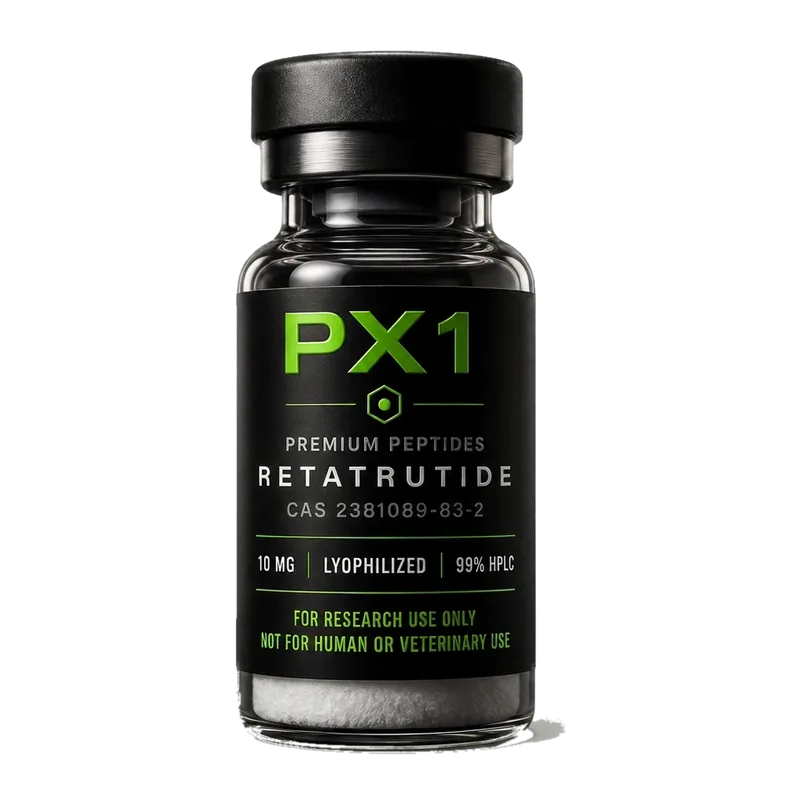
PX1 Labs Retatrutide 10 mg research peptide vial
★ Flagship · BestsellerFat Loss & Metabolic

Retatrutide

Triple-agonist for appetite and weight management · 4–8 mg/wk · 16+ weeks

Triple agonist (GLP-1 / GIP / glucagon) · 39-residue peptide

The “next-generation” GLP-1 — a triple agonist (GLP-1 / GIP / glucagon) linked to the largest weight changes in recent trials.

€89.9510 mg · LyophilizedIn stock
Buy more, save more price per vial
€89.95 ea
€85.45 ea −5%
€80.95 ea −10%
€76.46 ea −15%
10× €71.96 ea −20%

Volume pricing applied at checkout — free EU shipping on every order.

Purity 99%+ HPLC
Shipping Free in EU
Documentation CoA included

For laboratory and in vitro research use only. Not for human or veterinary use, and not for use in diagnostic procedures.
🇪🇺 Stocked & shipped in the EU📦 Dispatched in 24h🚚 Free EU shipping✅ No customs lottery🧾 CoA in every box
ClassSynthetic peptide (triple incretin/glucagon agonist)
Half-life~6 days
Typical routeSubQ
Cycle16+ weeks
CategoryFat Loss & Metabolic
Price€89.95
🧾 View Certificate of Analysis

About Retatrutide

Retatrutide is a synthetic 39-amino-acid peptide engineered as a triple agonist of three metabolic receptors: GLP-1, GIP and glucagon. The molecule incorporates non-natural amino-acid modifications and a C20 fatty-diacid attachment that extends its plasma half-life — a structural strategy shared with semaglutide and tirzepatide. It is one of the most-studied incretin-class compounds in recent metabolic and obesity research.

PX1 Labs supplies retatrutide as a 10 mg lyophilized powder verified at 99%+ identity purity by HPLC, with identity confirmed by mass spectrometry. A lot-specific Certificate of Analysis is included with every order.

What it's known for

Retatrutide is best known for weight loss and metabolism. Here is what it is most associated with. (Still investigational; supplied for laboratory research use only.)

Weight loss

Known for substantial weight loss in its clinical trials.

Triple agonist

Hits three receptors — GLP-1, GIP and glucagon — hence 'next generation'.

Metabolism

Associated with blood-sugar and metabolic regulation.

Still in trials

NB: retatrutide is investigational and not an approved medicine.

Ozempic vs Retatrutide

One receptor versus the triple-agonist researchers call the next generation.

Ozempicsemaglutide
RetatrutidePX1
Receptors hit
1GLP-1
3GLP-1 · GIP · glucagon
Type
Single agonist
Triple agonist
Weight change in trials
≈15%
≈24%
Dosing
1× / week
1× / week
“Next generation”

Read the full Ozempic vs Retatrutide breakdown →

Phase-2 trial data: retatrutide ≈24.2% body weight at 48 weeks (NEJM 2023); semaglutide ≈14.9% at 68 weeks (STEP-1). Separate studies, different populations and durations. Ozempic® is a registered trademark of Novo Nordisk A/S; PX1 Labs is not affiliated with or endorsed by Novo Nordisk. Supplied for laboratory research use only.

The Retatrutide journey

Week by week — press play or drag the slider.

🥄
Week 1
Start low — appetite begins to quiet down.
Body weight 100%
commonly reported trend

Commonly reported in research and by self-experimenters — individual results vary and are not guaranteed. Research use only · not medical advice.

Retatrutide explainers

Curated clips from across social media.

Swipe for more clips →

How it works

Retatrutide acts on three metabolic receptors at once — GLP-1, GIP and glucagon (a 'triple agonist'). GLP-1 and GIP reduce appetite and slow stomach emptying; glucagon influences energy expenditure. The combined effect across the three axes is why it is associated with strong weight loss.

What the evidence shows

Retatrutide has phase-2 human trials with substantial weight loss; phase-3 trials are underway. It is NOT yet an approved medicine — unlike semaglutide (Ozempic/Wegovy) and tirzepatide (Mounjaro), which are already on the market.

An educational summary, not a treatment claim or medical advice.

Side effects & safety
Reference information — not medical adviceSummarised from public research literature. PX1 Labs products are supplied for laboratory research use only; not for human or veterinary use.

Commonly reported

  • Nausea, vomiting, diarrhoea or constipation (dose-dependent)
  • Reduced appetite
  • Injection-site reactions
  • Increased heart rate

Cautions & contraindications

  • Still investigational (Phase 3) — long-term safety unknown
  • Slow titration limits GI side effects
  • Avoid with personal/family history of medullary thyroid carcinoma or MEN2
  • Monitor for gallbladder and pancreatitis symptoms
  • Avoid in pregnancy
Dosage chart (reference only)
Commonly cited ranges — not a recommendationBeginner / standard / advanced figures collected from public, widely available community references. Provided for reference and comparison only — not a dosing instruction or medical advice. Supplied for laboratory research use only.
BeginnerStandardAdvanced
1 mg/wk4–8 mg/wk12 mg/wk
Frequency1× weekly
TimingSame day each week
Cycle length16+ weeks
Typical routeSubQ

Convert any dose to a syringe draw →

Reference protocols
Reference only — not a recommendationThe figures below are commonly cited in public and community references. They are provided for reference and comparison only — not a dosing instruction, recommendation, or medical advice. PX1 Labs products are supplied for laboratory research use only; not for human or veterinary use.
ContextCommonly cited amountFrequency
Titrated in trialsstart low (e.g. ~2 mg) and increase gradually1× weekly

Reconstitution example: e.g. 10 mg + 1–2 mL → work out the weekly draw in the calculator.

In clinical trials a weekly injection, increased slowly by tolerance. NB: still in clinical trials, not an approved medicine.

Work out your own draw in the calculator →

What researchers commonly report — by week
Commonly reported, not guaranteedThese timelines summarise what self-experimenters and widely available community sources describe. Individual results vary widely, many notice nothing on this schedule, and these are not promised outcomes. Reference information only — not medical advice. PX1 Labs products are supplied for laboratory research use only.
Week 1–2
Appetite suppression usually noticeable quickly; mild GI effects common during titration.
Week 4–8
Steady weight reduction commonly reported as the dose titrates up.
Week 12+
Largest reported changes; slow titration cited to limit side effects.

Specifications

Every PX1 Labs lot is independently verified before dispatch. The figures below describe the product class; exact lot-specific results are documented on the Certificate of Analysis included with your order.

Compound classSynthetic peptide (triple incretin/glucagon agonist)
CAS number2381089-83-2
Molecular weight≈ 4731 g/mol
Identity purity99%+ (HPLC)
Identity confirmationMass spectrometry
Presentation10 mg lyophilized powder
Physical formSterile-filtered, freeze-dried
Storage2-8°C; -20°C long term
DocumentationLot-specific Certificate of Analysis

Documentation & quality

Retatrutide passes the same five-stage PX1 quality process applied to every product: HPLC potency analysis, mass-spectrometry identity and purity confirmation, pH and stability validation, sterility and endotoxin (LAL) testing, and QC batch-consistency verification.

A lot-specific Certificate of Analysis ships with every order. The lot number printed on your vial matches the lot ID on the document, so the material on your bench can always be checked against the data on file.

References & research

Selected peer-reviewed literature on Retatrutide (via PubMed), provided for educational context. A reference does not imply a clinical claim for PX1 Labs products.

  1. Triple-Hormone-Receptor Agonist Retatrutide for Obesity - A Phase 2 Trial.
  2. Retatrutide - A Game Changer in Obesity Pharmacotherapy.
  3. Triple-Hormone-Receptor Agonist Retatrutide for Obesity (correspondence).

Retatrutide — questions

What makes retatrutide unusual?

Retatrutide is a triple agonist — it activates three receptors (GLP-1, GIP and glucagon) in a single molecule. Most incretin-class peptides target one or two of those receptors; the triple-agonist combination is the focus of newer metabolic research.

How is retatrutide supplied?

As a 10 mg lyophilized powder in a sealed vial, with a lot-specific Certificate of Analysis. It should be reconstituted only in an appropriate laboratory setting following your own validated protocol.

Often paired with

Documented peptides, on your bench tomorrow.

Every PX1 order ships within 24 hours with full analytical documentation in the box.

🛒 Telegram Shop
€89.95🛒 Order on Telegram